
Travel Marks
A place worth remembering, saved with its name and where it is. Not yet a visit.

What it is
A place you want to remember.
Travel Marks remember or consider places: a restaurant, a shop, a view, a hotel. A mark carries the place’s name and, where a lookup finds it, its address and position on a map.
People save marks for places they mean to go, places they went, places someone mentioned, and places they would send a friend. A mark can be saved long before any visit, or with no visit at all.
Mark and Check-in
The mark is the place. The check-in is the visit.
A travel mark says a place is worth remembering. A check-in says you were there, on a date or for a stay, with anything you want to say about it. Discriminantly never turns a mark into a visit on its own, and never infers a visit from a plan or a mention. A mark does not mean you have been, or that you recommend it. Going is a check-in; recommending is a warrant.
Where a mark can sit
Collections and itineraries.
A mark can belong to any number of collections, and can be a stop in any number of itineraries. Adding a place to a plan keeps it as a mark if it was not one already. Removing a stop from a plan leaves the mark where it is.
With an authorized AI
Retrieved, and added, when you ask.
A connected assistant can find your marks, by place, city or the words you used, and can save a new one when you ask it to. It is asked to look the place up first, so a mark carries a real address and map position rather than a guess. Every mark an assistant adds is recorded as that assistant acting for you.
Private or public
Your choice, per mark.
A mark is visible to other members unless you mark it private. A private mark is seen only by you and by assistants you have connected. Check-ins follow the privacy of the mark they belong to. If a private mark is added as a stop in a plan you share, the place details in that plan (its name and address) may become visible to collaborators, after you confirm. The mark itself, your reason for saving it, your check-ins and the rest of your record stay private.
In the application
From members’ own records, on a phone.

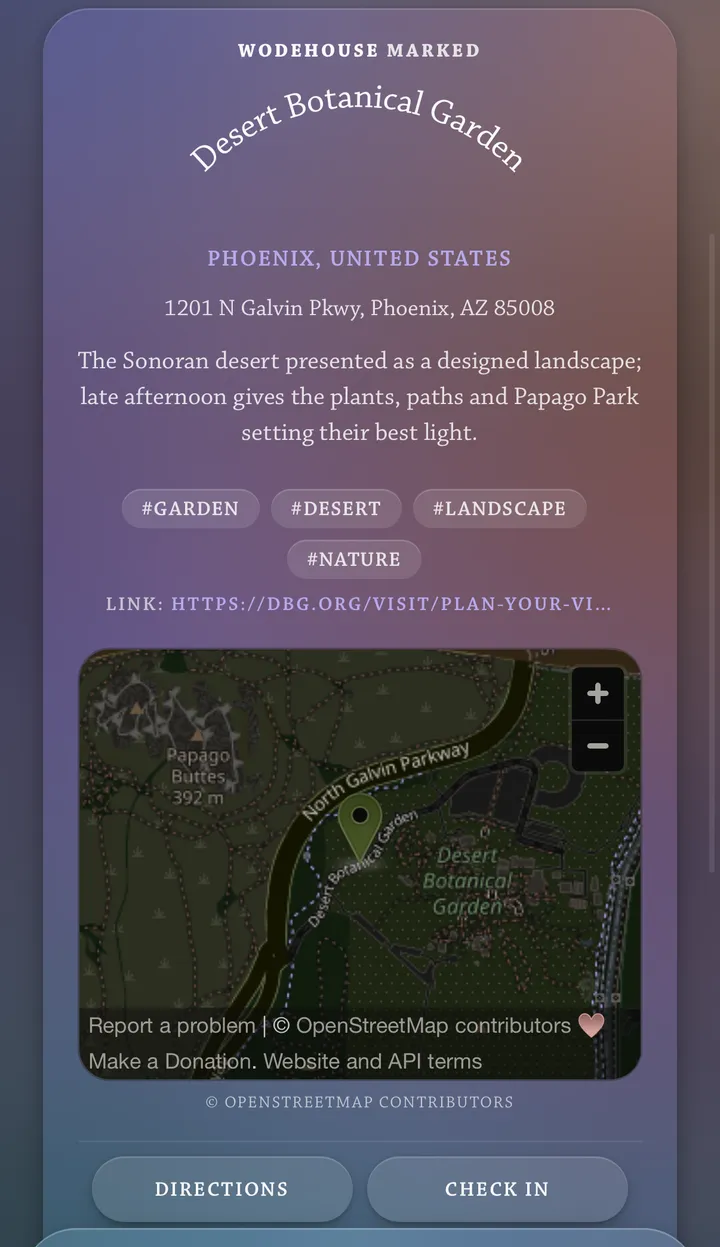
Enrichment and experience
What was looked up, and what you said.
A mark’s address and map position may be looked up for you, and are recorded as looked up. Your reason for saving it, and your check-ins, are yours and are recorded as yours. The two are held apart, so a researched fact is never presented as your experience.
An example
What a travel mark looks like.
Illustrative example Invented records, shown to explain the product. Not a real member.
What a mark proves, and does not
Saving is not going.
Proves
- A mark proves a place was worth saving, as you put it.
Does not prove
- A mark does not prove you visited. A check-in does.
- A mark does not prove you recommend the place. A warrant does.
- A mark in a plan does not prove the plan happened.
- A looked-up address is a fact about the place, not a statement by you.