
Remember places without claiming a visit
How can I save places I want to visit without pretending I have been?

The short answer
How can I save places I want to visit without pretending I have been?
Save a place as a Travel Mark. A mark records that the place is worth remembering or considering, with its name and, when a lookup finds it, its address and map position. It never records a visit. A visit is a Check-in, which only you add, and only when you went.
The mark
A travel mark is a place: a restaurant, a shop, a hotel, a view. Give it a name and a city; Discriminantly looks the place up and records the address and coordinates as looked-up facts, marked as such, apart from anything you wrote. You can save a place years before any visit, or never go at all.
The visit
A check-in is the record that you were there: a date, or a stay of several days, with anything you want to say about it. Check-ins are never inferred from a mark, a plan, a mention or a photo. Several visits are several check-ins. A visit whose date you cannot remember is recorded as a visit with an unknown date, never with a made-up one.
Privacy
A mark is visible to other members unless you make it private. Check-ins follow the privacy of their mark. If you add a private mark to a plan you share, the place’s name and address appear in that plan to the people you invite, after you confirm; the mark itself and your notes about it stay private.
Recommendations are not marks
When an assistant suggests a place, it stays a recommendation, listed as such, until you keep it. Keeping turns it into a mark in your record. A place you have dismissed does not become a dislike; it is just not kept.
With an AI
A connected assistant can save a mark when you ask, after looking the place up so the address is real rather than guessed; find your marks by city or by the words you used; and record a check-in only when you tell it you went.
In the application
What it looks like on a phone.
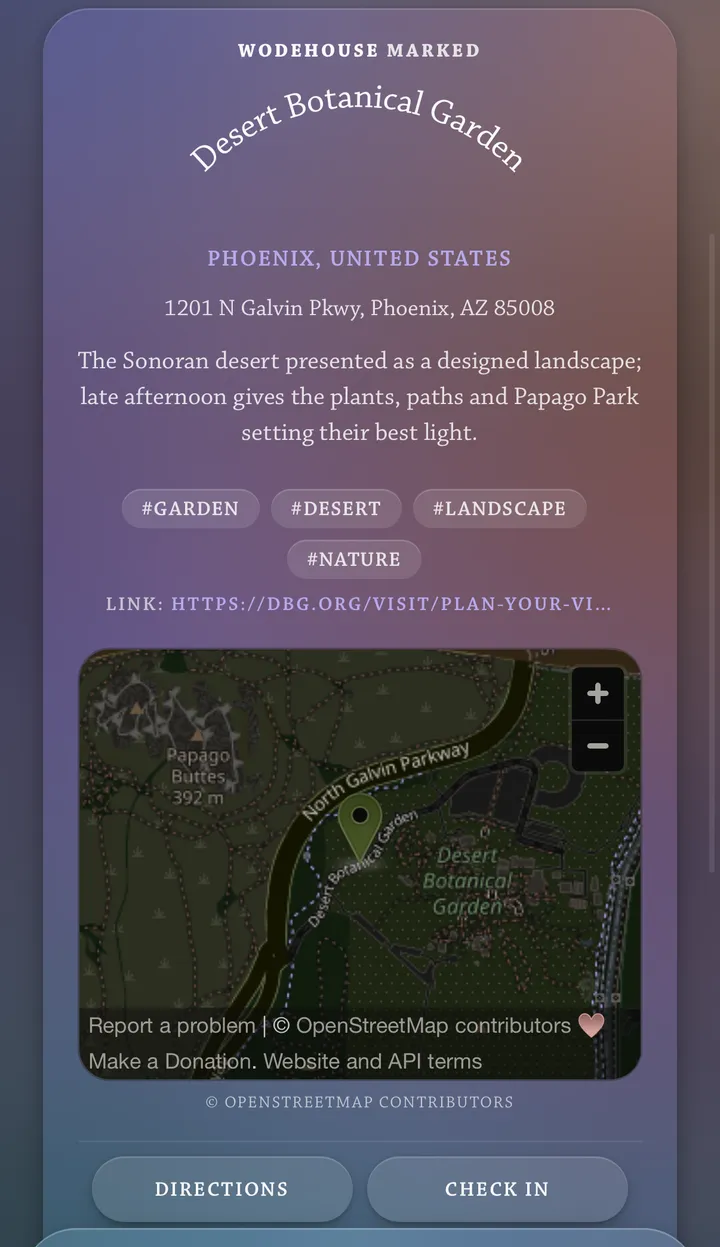
An example
What it looks like.
Illustrative example Invented records, shown to explain the product. Not a real member.
Related
Where to read on.
Last updated .