
Check-ins
The record that you were actually there. Added only by you, only when you went.
What it is
Visits and experiences.
Check-ins record actual visits: a date, or a stay, and anything you want to say about it. A check-in belongs to a travel mark.
What keeping one asserts
Exactly this.
A check-in asserts a visit: a date, or a stay with a first and last day, on a travel mark, with anything you want to say about it. A visit whose date you cannot recall is recorded as a visit with an unknown date.
What it does not assert
And never implies.
It asserts nothing about liking the place, recommending it or planning to return. It is never created from a plan, a mark, a photo, a mention or an assistant’s guess.
How it relates to the others
Separate records, separate meanings.
A check-in belongs to one travel mark. Several visits to the same place are several check-ins. A plan’s stop never becomes a check-in on its own.
Where it appears
In the application.
On the mark’s page, in your activity, and in the “On this day” resurfacing when a dated visit comes round. Check-ins follow the privacy of their mark.
In the application
From the member’s own record, on a phone.

With an authorized AI
Retrieved, and added, when you ask.
A connected assistant records a check-in only when you say you went. It is told that mentioning a place, or planning to go, is not a visit, and to ask rather than guess a date.
Privacy and provenance
Per record.
A check-in is as public as its mark. Deleting a check-in removes it; the history of changes keeps that it existed.
An example
What a check-in looks like.
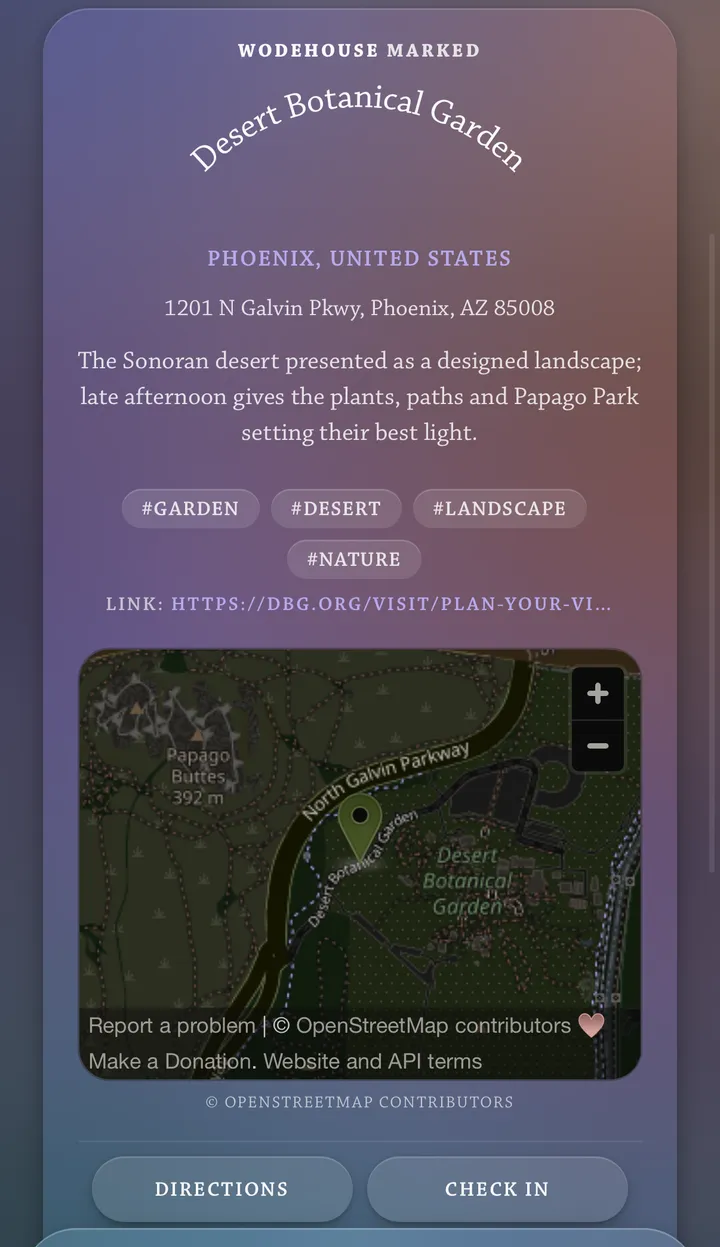
Illustrative example Invented records, shown to explain the product. Not a real member.
What a check-in proves, and does not
Plainly.
Proves
- A check-in proves a visit, as you recorded it. Nothing proves a visit otherwise.
Does not prove
- A check-in does not prove endorsement.
- A stay of several days is one check-in with a range, not several visits.
The other records
Each with its own page.
- Notes — Objects and interests
- Travel Marks — Places
- Collections — Groups of related records
- Itineraries — Plans
- Warrants — Things you stand behind