
Notes
A thing worth remembering, in your own words. Not a claim to own, like or endorse it.
What it is
Objects and interests.
Notes remember objects and interests: a thing, a maker, an idea. A note records that you thought it worth remembering, with a line on why.
What keeping one asserts
Exactly this.
Keeping a note asserts one thing: you thought it worth remembering. The headline and the line beneath are yours; tags, a link and a picture go with it.
What it does not assert
And never implies.
It does not assert that you own it, bought it, like it, use it or recommend it. Owning is a separate record you make deliberately. Recommending is a warrant. Neither is ever inferred from a note’s existence or its wording.
How it relates to the others
Separate records, separate meanings.
A note can sit in any number of collections, and can be attached to a stop in an itinerary (a coffee to buy at a roaster, say). It is never a place: places are travel marks.
Where it appears
In the application.
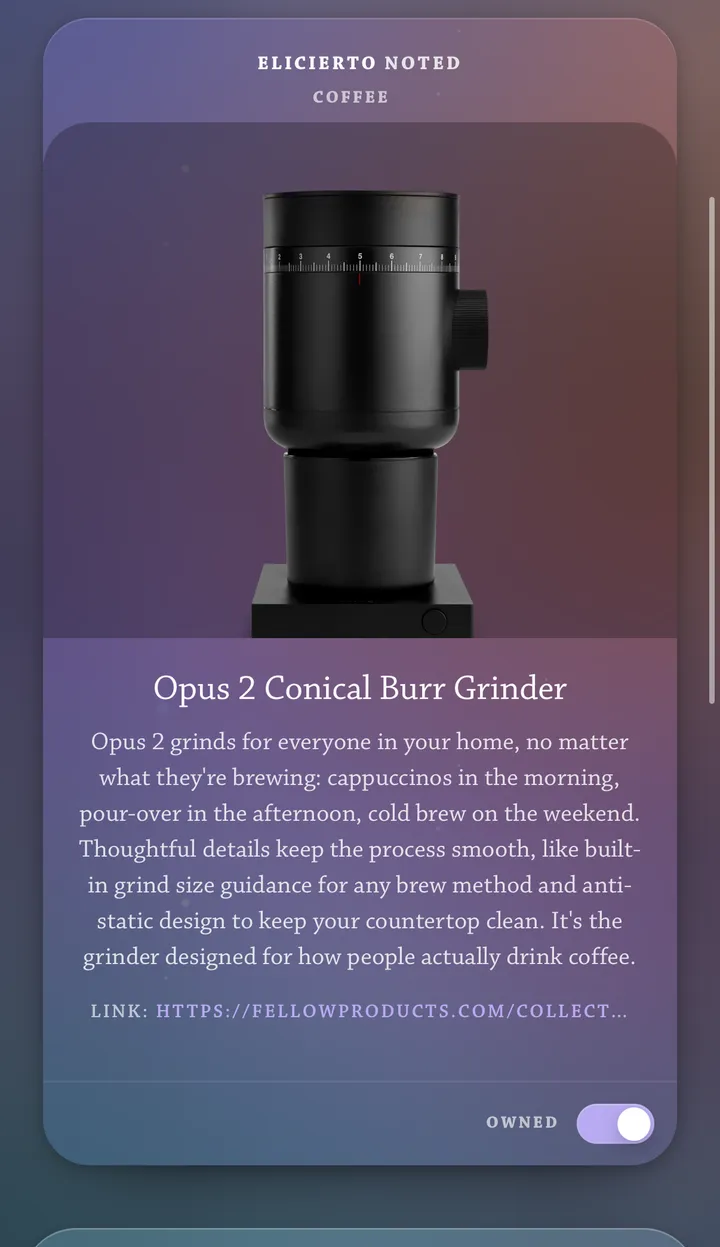
On your profile under Notes, in your collections, in search, and in the All feed when public. A note page shows the note, its picture, who noted it, and the comments on it.
In the application
From the member’s own record, on a phone.


With an authorized AI
Retrieved, and added, when you ask.
A connected assistant can find your notes by words, tag or collection, save a new one when you ask, and adjust an existing one. It is told to write in your voice and never to record ownership or endorsement unless you say so.
Privacy and provenance
Per record.
Public by default, visible to other members and anyone with the link; private when you say so, then visible only to you and assistants you have connected. Every change records who made it.
An example
What a note looks like.
Illustrative example Invented records, shown to explain the product. Not a real member.
What a note proves, and does not
Plainly.
Proves
- A note proves you thought it worth remembering, in your own words.
Does not prove
- A note does not prove you own the thing. An ownership record does.
- A note does not prove you recommend it. A warrant does.
- A note in a plan does not prove you bought it on the trip.
The other records
Each with its own page.
- Travel Marks — Places
- Check-ins — Visits and experiences
- Collections — Groups of related records
- Itineraries — Plans
- Warrants — Things you stand behind