
Itineraries
Places and ideas arranged into days and stops. A plan, saved; never a record of going.
What it is
Plans.
Itineraries preserve plans: places and ideas arranged into days and stops. A plan can start from a direct request, from places you have already saved, or both, and it can be shared or built with others.
What keeping one asserts
Exactly this.
An itinerary asserts an intention: these places, in this order, on these days or without days yet. Stops can be your existing marks, new places, or labels to resolve later.
What it does not assert
And never implies.
It does not assert that you went, that you will go, or that you recommend any stop. A completed trip is recorded by check-ins on the places you visited, not by the plan.
How it relates to the others
Separate records, separate meanings.
Adding a place to a plan keeps it as a travel mark if it was not one already; adding an existing mark reuses it. A stop can carry an attached note. Recommendations an assistant makes for the plan stay recommendations until kept.
Where it appears
In the application.
Under Itineraries on your profile, on its own page with a map of its stops, and, when published, in the All feed. Shared plans show who did what.
In the application
From the member’s own record, on a phone.

With an authorized AI
Retrieved, and added, when you ask.
A connected assistant can build a plan from a destination and what you ask for, even with an empty record, or draw on places you have saved, or combine both; it can add and arrange stops, attach notes and recommendations, and check the plan is complete. It is told to reuse places already in your record rather than duplicate them.
Privacy and provenance
Per record.
Plans start private. A plan can be shared by link for viewing and copying, or by invitation for working on together; neither shares the rest of your record. Publishing makes a plan visible to everyone.
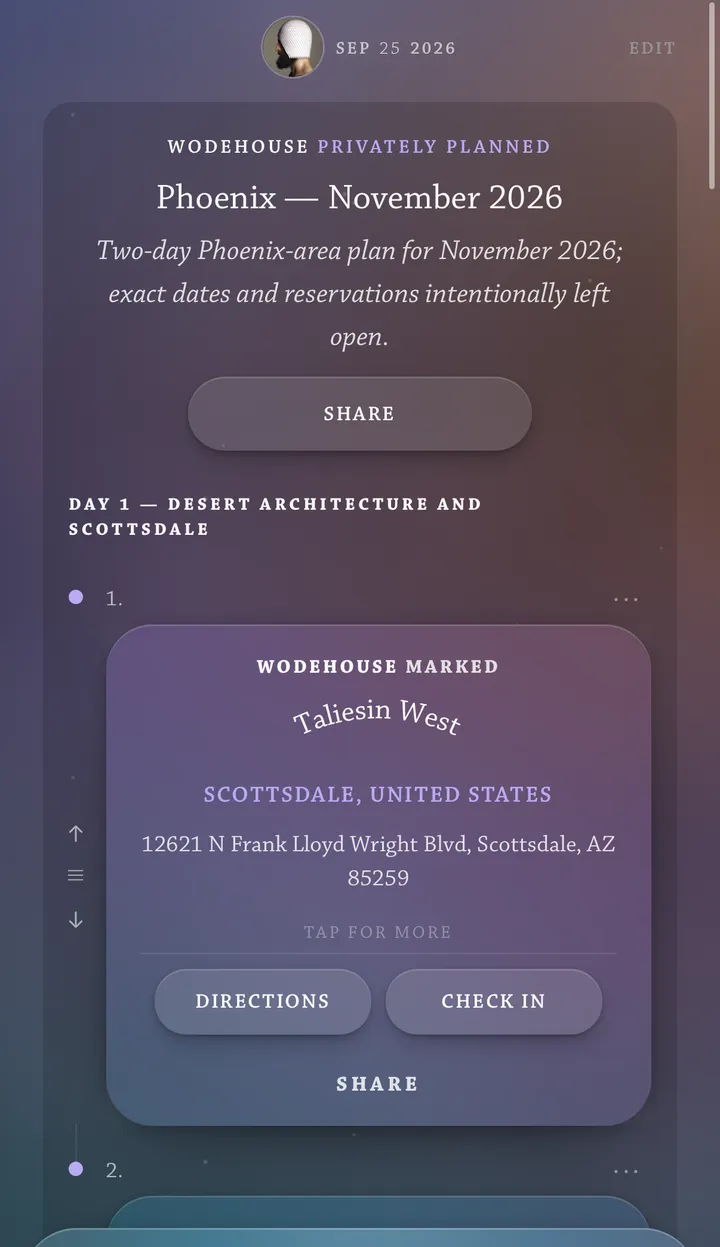
An example
What a itinerary looks like.
Illustrative example Invented records, shown to explain the product. Not a real member.
What a itinerary proves, and does not
Plainly.
Proves
- An itinerary proves an intention: these places, in this order, on these days.
Does not prove
- An itinerary does not prove the trip happened.
- A stop does not prove a visit; a check-in does.
- A stop does not prove a recommendation; a warrant does.
The other records
Each with its own page.
- Notes — Objects and interests
- Travel Marks — Places
- Check-ins — Visits and experiences
- Collections — Groups of related records
- Warrants — Things you stand behind