
Collections
Records, grouped under a name you choose. Organization, with no claim attached.
What it is
Groups of related records.
Collections organize records: notes and marks brought together under a name of your choosing, such as a city, a theme, a trip or a kind of thing.
What keeping one asserts
Exactly this.
A collection asserts only that you chose to group these notes or marks together: a city, a theme, a trip, a kind of thing.
What it does not assert
And never implies.
Being in a collection adds no claim about any record in it: not owned, not visited, not endorsed, not even liked. A collection named “Favourites” is a name, not a warrant.
How it relates to the others
Separate records, separate meanings.
Collections hold notes, or marks. A record can sit in several collections. Collections are not plans: a trip you intend to take is an itinerary.
Where it appears
In the application.
On your profile, as a row of collections with counts, each opening to its records. Someone else sees a collection only when they can see at least one record in it.
In the application
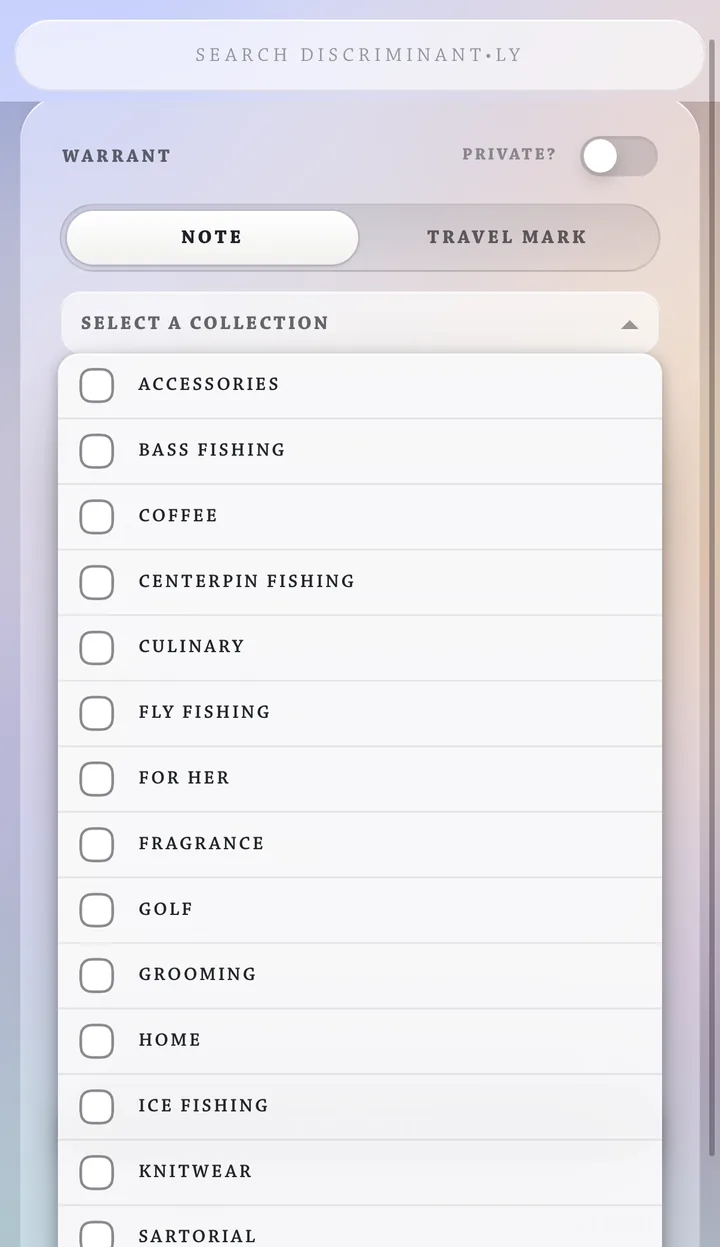
From the member’s own record, on a phone.

With an authorized AI
Retrieved, and added, when you ask.
A connected assistant can list your collections, find records by collection, and place a note or mark in a collection when it saves one for you.
Privacy and provenance
Per record.
A collection’s name is visible to others only through the public records it contains. Private records stay private inside any collection.
An example
What a collection looks like.
Illustrative example Invented records, shown to explain the product. Not a real member.
What a collection proves, and does not
Plainly.
Proves
- A collection proves you grouped these records under a name you chose.
Does not prove
- A collection proves nothing about its members except that you grouped them.
The other records
Each with its own page.
- Notes — Objects and interests
- Travel Marks — Places
- Check-ins — Visits and experiences
- Itineraries — Plans
- Warrants — Things you stand behind